This is the account that Wahine passenger survivor Kay McCormick wrote in her diary following her rescue from the seas of Wellington harbour on 10th April 1968. It is reproduced here in full, without editing or deletions. The picture of Kay was taken at Wellington Railway Station, which was used as an assembly point for survivors. Both the photo and the account are © Kay McCormick

Kay McCormick

From my Diary: Wednesday 10 April 1968
by Kay McCormick (aged 19)

Well today I was shipwrecked. It seems strange to put a day and date to it. It was just the day the Wahine went down for me.

Woke about 6 am. Had a cup of tea, very rough and still feeling seasick. The stewardess said we would be inside the harbour at 6.10 so we decided to stay in bed 'til after then. But the sea was just getting rougher. I didn't like it. Decided I'd like to get up on deck and see what was going on. So we were lying on our bunks getting dressed (it was too rough to stand up) when we heard the announcement about 6.30 to get our lifejackets and go to muster stations (we'd missed previous announcements with the noise of the ship and the sea and wind). A steward came in and did us up into our lifejackets and told us where to go. I reached for my purse and he said to leave that, just clear out quick.

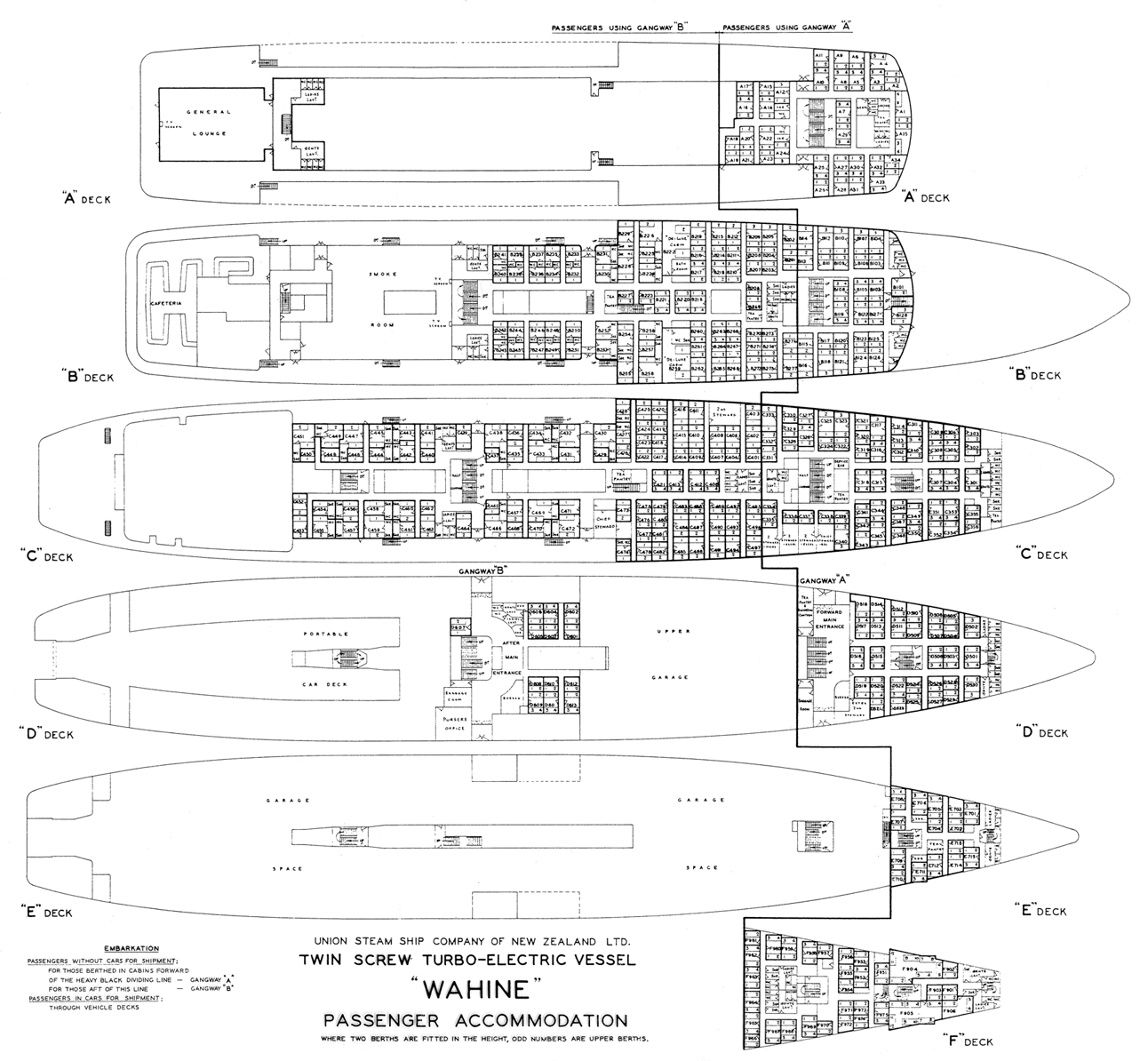
Upstairs mothers and children were sitting down in the lounge (known as the smoke room), but of course there wasn't enough room for all of us in there. So I stood in the corridor just outside, beside the toilet, and Anne (my friend and fellow student nurse at Wellington Hospital, Anne Gray now Mrs. Anne Shillington) was sitting in the corner opposite. Every time I sat down (only tried it once) I felt sick, so I just stayed standing. For about seven hours.

There was around us a middle-aged couple, the man of whom put his head in his hands and stayed like that all day. There was a chap who looked like a well-off farmer, who thought everyone running the ship had "half a brain". There was an elderly couple, the woman of whom was a real live-wire, dead skinny and matter-of-fact, who had me in hysterics watching her drinking a bottle of Coca-Cola, with a walking-stick over her arm - and her husband just sat watching her with a grin. Opposite them was a young Maori couple, who took the opportunity to have a wee necking session and then went to sleep on one another's shoulders. There was another young Maori girl with them - on one side - and, on the other side, a middle-aged Maori man, who looked like a policeman, and who kept opening the door to the deck beside him.

I have never seen anything more coldly, wildly beautiful than the sea that morning - a million flecks of pure white in pale green mountains of waves. And between clouds of grey rain I could see the hills - so comfortingly close - of somewhere about Pencarrow I suppose.

The other lady in with us sat on the floor, in her nylons, with her hat on her lap, worrying about being late for a doctor's appointment at 8.30 - and she should have been catching a 'plane back to Christchurch at 9.30, because her mother was seriously ill. I would dearly love to - but suppose I never will - know how they all got on later.

During the day stewards kept bringing around "food": tea, biscuits, sandwiches, cheese, tomato, lettuce, meat, bananas, salmon, Coca-Cola, Fanta, ice cream. I didn't eat any in case I was seasick again, but everyone seemed to be eating just for something to do. About hourly they put over reports that we were safe inside the harbour and drifting up it to Wellington. They were frustratingly vague, but now I'm glad we didn't know what was going on - I would have been in a panic.

Someone started a sing-song: "There's a hole in my bucket", "Michael row the boat ashore", "Rock my soul", "Rocking, rolling, riding out along the bay" and - the classic of them all - "We're on our way to Heaven, we shall not be moved".

We were told a tug was coming to pull us off. There was a great cheer when it arrived. But, as time went by, we could see that wasn't going to work. Through the door to the deck we could see the tug being bounced up and down by the sea, like it was a cork. And during the bad times the waves were splashing right in the top of that door.

I spent some of the morning putting little children on the toilet - I suppose it was just because I knew my way around the toilets. Lights, water and heat were OFF. I have found out since that one of the little girls - a wee three-year old blond - was drowned. The whole thing is so sad.

About 1 o'clock I suppose, the ship started what is called "listing" - just rocking to one side, and then straightening. It was a bit of a joke seeing people trying to walk at a 45-degree angle. Then one time it rocked to one side and didn't straighten up. Children, dishes, adults, chairs, tables and old people were toppling into one another in the lounge. Then everyone began running, to try and get out of the way of what was falling on them.

The announcement was made for everyone to report to starboard side. At this stage we were more or less sideways and the ship had been going backwards. Consequently there was general confusion. I never heard (I don't know if there was one) an announcement that we were abandoning ship - just the announcement, repeated in a young ever-increasingly higher pitched voice, to go to starboard side.

In my ignorance I thought the idea was that the weight of all the passengers on one side would straighten the ship (Apparently not so stupid: a few days later, as the Picton ferry neared the Wahine, it listed badly because so many passengers moved to the one side to see the wreck). We therefore went to the wrong side. A young American steward came and told us to go to the other side. Then Anne and I had an argument. I had seen the sea that morning and just didn't believe we would stand a chance on a raft in those waves. But Anne said she was staying with the crowd, so I said I would stay with her.

I remember an old Maori lady standing on the deck, giving up her beautiful rich singing voice to the sound of the wind and rain. A young man climbed onto the rail to jump overboard and swim and was stopped by loud screams. He turned around like he had just been woken up. Standing waiting in the corridor, with a tight grip on the rail to stay standing, I remember trying to persuade myself I might be going to die. But it was so impossible - to be happening in the middle of Wellington Harbour - and to be happening to me - that I just could not believe it.

By then the floor was at a very steep angle and the older people seemed to be tired of holding on and were sliding down, their hands bleeding from knocks they had received. It really pierced me, the attitude of the old people: they seemed to have decided they were just going to die. Some were praying, but others had become vacant already. Waiting, we could hear screams and crashes from the outside, but had no idea what was going on. Eventually it was our turn to leave.

Out on the deck the young American steward was still operating proceedings: standing against the wind and rain and ship and helping people over the rail with a "Ma'am". By this time the rail was at sea level and all we had to do was climb over it on to the rafts. We hauled in a few people out of the sea. I can remember thinking that it looked like a real shipwreck - like that film 'A Night to Remember' about the Titanic - hats and walking-sticks floating all around - but I still couldn't believe that it really was one. The raft kept bumping into the ship and the ship was tipping over further. I had read somewhere that, when a ship goes down, it sucks down with it all that is around.

There didn't appear to be any paddles on the raft. An officer on board said to paddle with our hands, but that didn't satisfy me. I took my shoes off and climbed over the side! (The rafts were those brightly coloured ones, with an inflated ring around and a tarpaulin overhead). I held onto the side and kicked absolutely flat out, 'til I was so exhausted I nearly didn't have the strength to climb back in again, with my bloody lifejacket in the way. Pathetic really, but when I looked around, we were past the ship. And all around us craft were coming to pick us up. I saw one little pleasure craft seeming to jump from the top of one wave to another. And looming near, hugely reassuring, the ferry Aramoana. I just couldn't get over the drama of the situation - everyone over-acting; it seemed to me - including myself. I was just too much.

Another raft came floating by and threw us a rope, so I held on to it. The Aramoana rose up in front of us, terrifyingly close. I thought it would slice us in two, but it passed us by in a gigantic wave that nearly swamped us. Then a rocket fired out over us and a pink nylon rope landed in the water nearby. We drifted over that way and I leant over and picked it up. I remember how warm the sea felt, compared to the freezing blizzard air.

The officer took the line then but, by the time he hauled us in, we were swept past the Aramoana and were getting too near the propellers. Another raft was even closer than us and looked as if it might disappear under the back of her, but a further wave swept it out again. We heard their screams.

Those waves were so enormous. Each one lifted us so high I thought we must surely tip over. Then the wave would disappear from beneath us and another one would be coming towards us, as high as I could see. I was torn between the feeling of wanting to be seasick and the worry that, having survived all this, I would land up in Wellington Hospital with pneumonia - in the middle of my holidays.

But there were more boats coming towards us. I was so excited at the way people were coming to help us. I kept turning around to tell everyone inside the raft, but they looked at me as if they hadn't heard - or as if they couldn't understand me. There was an old man and an old woman on board who had become as if deaf and paralysed. Anne was sitting nursing a baby the officer had handed her. She told me later that she was being seasick all over the old man's coat and kept apologising to him, but he didn't seem to either hear or see her. Another overweight middle-aged woman was screaming because she was sitting on her own legs, but just was not able to move them herself.

I have no idea how long we sat on the raft, getting colder and colder, but next another craft came along, small enough for us to get on it, and not large enough to swamp us - Arehimo I think she was called - and did she look safe and sturdy - the same tug that had seemed so flimsy that morning, seen from the ship.

A rope was thrown out. I caught it and we were hauled in. The waves were washing up deck height on the tug and all the men on board were standing around the deck, inside the rail. We were safe. "Darling" I heard - and a big laughing bearded man picked me up in his arms and put me down on the tug deck. I waited until Anne was lifted on board too and then we went inside - into such warmth.

They had us all sitting and standing on a grill, halfway up the boiler: I just put my arms and chest right against it. Steam burnt my leg, but I couldn't bear to move away - and gradually the shuddering stopped. The officer came in, patted me on the shoulder and said "How are you Miss? All right?" I offered to take off his lifejacket: they were so bulky we had taken ours off and left them on the tug deck. But he said he had tied his on so tight he could hardly breathe - but he wasn't taking it off 'til he got on dry land - as he couldn't swim! A young steward nearby overheard and said he couldn't either: "You're not getting me on any boat again" he said wildly, "I'm quitting this job, as from right now". "Oh I'll be on the next one that goes down - and the one after that" replied the officer "but tonight I'm going to have a party at my flat and get drunk".

By now I was wishing I could go too! I was also wondering what had happened to the young American steward. A girl in the NZWAAF started talking to me too about Death. She had thought she was going to drown, but said it would have just been an end, not really anything to fear. I just agreed. But, when I had been waiting to get off the ship, I had thought about all I was doing and it just didn't fit that it was all going to end. When would I paint my masterpiece?

Poor Anne was sitting down, still being seasick - through the grill and onto the floor below, narrowly missing a man below, who was trying to stoke the boiler or something. That trip in on the tug seemed to be the longest part of the day for some reason. I could see a wedge of the passing land and sea and I nearly cried when we passed Oriental Bay - it looked so normal. There was the red brick monastery and its white cross. I was not dead then. I had been so sure I would be - just wondered how long it would take and how cold it would be - until my mind switched off that thought.

And finally we arrived at the Ferry Terminal Wharf. One lady sitting behind me looked dead. I leaned over to tap her on the shoulder and asked if I could help her off. A pair of bright blue eyes suddenly opened and looked at me. "Are we ashore?" she asked. The up she got and fairly strode off! The first lady off the tug however was bad. She was helped off on two men's shoulders and later I heard she had died a few minutes after in an ambulance.

I don't remember any particular elation at being on "dry" land again. But I remember a feeling of utter terror seeing that pale green sea leaping at the wharf. And there were the TV cameras, reporters and spectators. I had been wondering when they were going to turn up. Anne was about second off the tug and I was about fifth - and I couldn't see her anywhere ahead - so she must have run even faster than me! A bus was waiting there, to take us to the Railway Station.

Reunions had started already. A woman off our raft had found her husband and they were sitting on the bus with their heads together, their smiling faces washed in tears. A Chinese man asked the bus driver if he had seen an elderly Chinese lady come ashore and, when he replied that she had gone ahead in a taxi to the station, the man put his wife and children on the bus and then ran to the station on foot, a grin from ear to ear.

It was mercilessly cold sitting on the bus and, being amongst the first on, we had to wait 'til it filled before we were driven over to the station.

At the Railway Station blankets were wrapped around us and then we gave our names to the Police and followed others in to the dining room. I had a terrible pain in my stomach and thought I should be hungry, so got myself a big plate of stew, toast, coffee and sat down to eat it and didn't feel like it. I pushed about half of it down, looked up and saw Mike (Michael Burgess, NZ Writer I had met at a party a few weeks prior to my holiday) ambling through. I automatically put my hand up and waved, then wished I hadn't, looking - I was going to say "like a drowned rat" - well, I suppose that is very appropriate. He saw me and came over. Just took my photo, said "That'll be a masterpiece" and moved off again. Fancy going through all that to see him again!

Trying to work out what to do. The young policeman we gave our names to said that all telephone wires were down. One of the waitresses came over to talk to us. She was supposed to be off duty at 2 o'clock (it was about 4 o'clock by now), but had been asked to stay on just to feed us. She thought the lines would be up by now, so we went out to try.

The operator put me straight through to home. I could hear her asking Mum if she would accept a call from me and Mum absolutely jabbering with relief - my Mum! - she never gets flustered! I just managed to put the receiver down after, then turned into the corner, my face down into the blanket and started sobbing.

So then Anne was crying too. By the time they put her through she could hardly say "Hello". When she hung up we stayed in the telephone box crying for a few minutes and laughing at ourselves. Then we went out, to let the next in, and walked back into the dining room. It was across a long stretch of concrete and I realised there were wooden trestle tables up and people behind them, standing looking dumbly at us. As if they weren't sure they could believe their eyes.

The baby Anne had nursed in the raft was being fed a bottle by its mother. Its father was out ringing up his parents - somewhere up Gisborne way I think. They had lost "everything" on the ship.

We must have sat there some time. I was feeling remote now. I don't know how long it was. I went out to try and ring my Aunty Lois again, but it was still no go. A young man, a Dominion reporter, came up to ask us questions. And in the middle of it Uncle Keith (Uncle Keith = Keith Froggatt, Chief Accountant NZR; Aunty Lois = his wife; Doug = their son / my cousin) found us. Mike had directed him. Thank goodness Anne didn't give the reporter our names. Not one single statement we were attributed with was ours.

Uncle Keith took us upstairs in the station to his office, a heater and privacy. We sat on the carpet drying, wrapped in our rugs. Anne wrung out her socks while Uncle Keith tried to get Aunty Lois on the 'phone. When he did get through Doug had just arrived home. He came flat out in his car to get us.

It was about 6 o'clock by now and I went downstairs to meet Doug, and Anne to meet her parents - who had left Levin to come down for her when she rang.

Aunty Lois was waiting (my Aunt & Uncle lived in Linden, Wellington) with open arms: "It wasn't until we nearly lost you we realised what it would be like without you" she said. That's a bit melodramatic I thought. She had a neighbour's daughter's big warm jumper, blouse and slacks for me. I put on a big pair of Doug's cricketing socks too and I was dry!

I sat in front of the heater and ate dinner. Aunty Lois had cooked my favourite pudding for me! It seemed so incongruous - such a fuss.

By now the ground outside was dry, and there was not a breath of wind! She told me that if the weather stayed calm - they would drive me up to Napier where my parents lived, the next day after lunch for Easter. I was so relieved. I wanted to feel sheltered and safe for the next few days.

At 7.30 p.m. the News came on TV. Then I saw what had happened. That morning I had just been it - now I was an onlooker. It was so terrifying. They interviewed one woman who we had seen that morning - a woman of about 65, in a good jersey suit, hat, spectacles, standing in high heels, feet astride and arms folded, carrying a handbag - while others around clung for dear life to the rails, or sprawled over the floor. But, underneath her name was written WAHINE SURVIVOR. Survivor? Survivor. Survivor! A ship had sunk! 200 missing! And I was "a survivor"! That really shook me. I went to bed then.

Next morning Aunty Lois had washed my slacks and jersey. I have a strange affinity for them now. I wonder if I shall ever wear them again? Or ever throw them out? I am afraid I just sat around all morning and - try as I could - could not organise myself. I was shattered. I just listened to the news. The neighbour came in and gave me five dollars "to buy new underwear" and I didn't know what to do - just cried. Then Aunty Lois took me to the shops at Porirua. I bought a purse and put my change in it. Then I bought a comb, a toothbrush and a lipstick. I sent Mum a telegram telling her what was going on but, when we got back from shopping, she rang.

Uncle Keith came home from work about 12 and after they had lunch (I did not feel like eating) we left. The journey to Napier where my parents lived has never seemed so long. I kept picturing myself walking over the lawn, up the steps to our front door and the tears would come. And finally, at 7.30 p.m. on Thursday 11th April 1968, there I was going up the front steps and I was crying. First Mum, then all my brothers and sisters, just standing there saying "Hello Kay" and then a big hug from my Dad. Home at last.


This account is by Wahine steward and crew survivor Frank Hitchens. It is reproduced here in full, without editing or deletions.

Kay McCormick
Photo acknowledged to the Dominion and Sunday Times newspapers.

Steward Frank Hitchens lies shoe-less and unconscious on the back of a Landrover making its way north along the Pencarrow road, his legs handing over the rear of the vehicle. At right, the canvas canopy of a New Zealand Army Bedford RL truck can be seen parked near the bottom of the track that climbs over the Pencarrow hills to farmland in Gollans Valley. Burdan's Gate, where ambulances were parked and waiting, is about a kilometre ahead of the Landrover. Note the condition of the road. Survivors on foot, most without shoes, had to walk for miles through rock debris washed down from the hills by the rain and thrown up by the seas.

The 10th April 1968 will always be remembered as the date of the Wahine disaster. At the time I was working on the ship as a steward and enjoying the life of being at sea.

The trip up from Lyttleton was fairly routine with a gale force southerly pushing us along towards Wellington. Abeam of Baring head the wind speed increased considerably, with heavy rain and reduced visibility. As the Wahine reduced speed to enter the harbour entrance, it veered off course towards the shore at Pencarrow Head. The captain attempted to reverse the ship away from the shore but the ship turned round in an arc and went stern first on to Barrett Reef. The radar had become unreliable and visibility was reduced to the point where the shore could not be seen from the ship. Going aground caused one propeller to be ripped off and a long hole was opened in the hull below the waterline, allowing the ship to become partially flooded, reducing its stability. After some time, the ship was blown off Barret Reef and it drifted up the harbour dragging its anchors towards Seatoun.

We rode out the storm during the morning while the tug boat Tapuhi tried to get a line on to the Wahine's stern to attempt a tow in to Wellington, but failed to do so. About 1 PM the wind had died down again but the sea swells in the harbour will still quite high and combined with the out going tide the Wahine started to capsize to eventually settle on the harbour floor on its starboard side with the port side above water level.

When it came time to abandon ship, I assisted passengers to get from the open door down to the ship's rail to board the four available life boats (life rafts were also used); the steel decks were very slippery with a steep slope down to the rail and not very easy to negotiate. Well all the passengers had exited the door; I slid down the steepening deck to the rail as the ship's list continued to increase as it was capsizing. The life boats were leaving the ship's side so I jumped over the side into the water and hung onto the rope along the life boat's side. I was soon pulled in to the Number 1 life boat, the one with an engine. But the boat became swamped and the engine stopped leaving us to drift at the mercy of the elements. The tug Tapuhi came along to try and rescue us but nudged the life boat and it capsized throwing us all out into the sea. [My second shipwreck in one day?] Most of us managed to swim back to the life boat and climb up onto the upturned hull.

By now, we were drifting towards the Eastbourne coastline where the waves were turning into big breakers and three times we were washed off the upturned hull; each time less people were going back to the boat and were being swept away from it. The tug came back and two men tried to pull me up onboard. However, by then I was getting too tired and couldn't help them to drag me up the side of the tug, so I told them to let me go and I then struck out for the shore, my life jacket keeping me afloat.

While in the water and swimming for the beach, I saw the Cook Strait ferry 'Aramoana' arrive on the scene to help with the rescue. Soon after its arrival, I saw the Wahine capsize on to its side and a ball of steam rose up from the vessel. I was aiming to go ashore between a group of rocks when another large breaker ducked me under again. Everything went dark and quiet and that was all I remembered until I woke up in the Hutt Hospital about 6 PM that evening. I had been washed up on the rocks by the wave and knocked unconscious. Luckily for me, I was also washed up on to the beach and eventually found by rescuers - other people were not so lucky. Forty seven of the 223 people thrown up on the rocks and shore along this coastline were killed.

I was placed on the back of Burden's flat deck truck along with some other injured people and taken to Burden's gate where I was transferred to an ambulance by two policemen. [I have the news paper photographs of myself 'in the arms of the law' and also on the back of the truck.] From there, I was taken to the Hutt Hospital where I was kept in under observation for three days before being released.

I now look back on the experience from two different viewpoints; one, it was an interesting adventure and experience for myself and two, it was a major tragedy due to the loss of life of fifty one people and the loss of an almost new ship. An experience myself and many others will never forget!

The Wahine tragedy will remain part of New Zealand's maritime history for ever.

Frank Hitchens, Wahine steward.

(c) Frank Hitchens


wahine Go to top of page